How a Retired Village Herbalist Helped Me Understand African Herbs Safely — And Finally Feel Better in Just Days
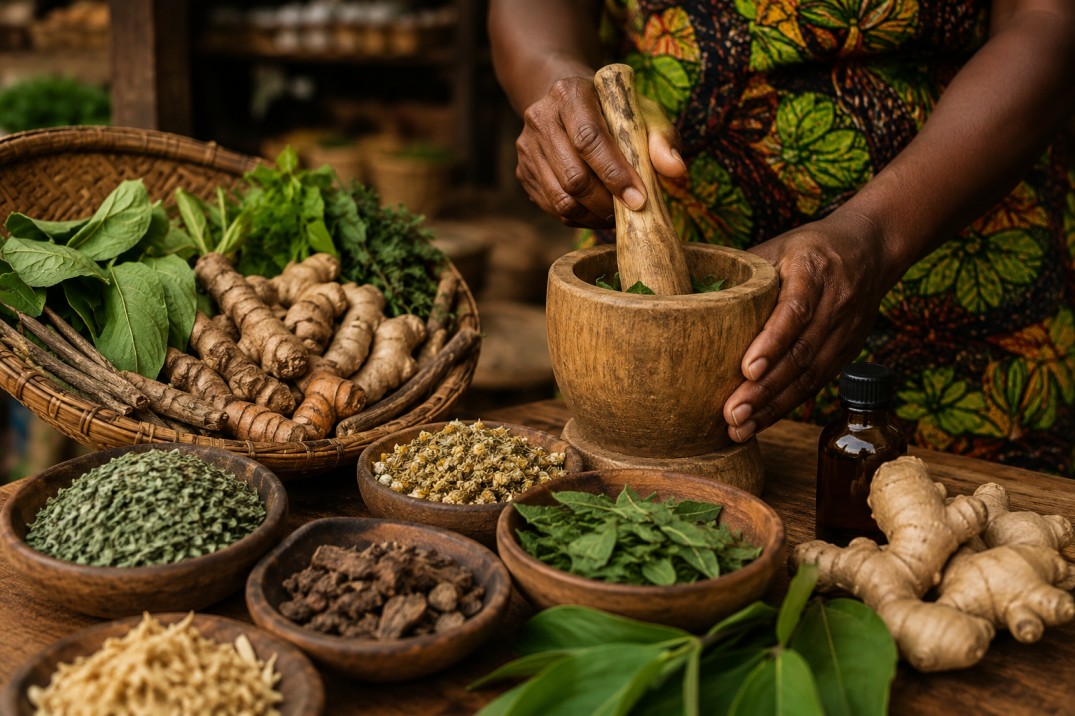
If you have been reaching for herbs your grandmother swore by — and they are either not working, or you are not sure you are using them right — read every word on this page.
If you have bought something from a roadside herb seller, stared at the bundle in your hand, and thought: how much of this do I use? How long do I boil it? Can I mix this with the other one?
If you have tried neem. Tried moringa. Tried bitter leaf. And nothing gave you the consistent result you were looking for.
The problem is not the herbs. The problem is that you are working without a map.
"I know. Because I carried that confusion too. For longer than I want to admit."
My name is Adomi Ochuko. I am not a pharmacist. Not a doctor. Just a woman from Delta State who spent the better part of four years trying to use African herbs — and mostly doing it wrong.

I grew up watching my grandmother work with plants the way other people work with a kitchen. Effortlessly. Purposefully. She knew what each leaf was for. By the time I was an adult in Lagos, I had forgotten most of what I watched — and tried to relearn it through YouTube, WhatsApp groups, Instagram pages.
I spent close to ₦80,000 in those years. On raw herbs from the market. Boiling things. Soaking things. Mixing things together that I later found out should never be combined.
In August of 2023, I travelled back to my mother's village in Delta State for a traditional naming ceremony. There was one woman seated under the mango tree at the edge of the compound — perhaps in her late seventies. Small. Very still.
Her name was Mama Eruotor.
She turned to me and said: "You are using the herbs. But you do not know how to listen to them."
I have never been more ashamed of my ignorance than in that moment.
The Discovery That Changed Everything
"You are not foolish. You just never had anyone teach you properly."
Here is what Mama Eruotor helped me understand:
Your body has a natural rhythm. African herbs were developed over thousands of years to speak directly to that rhythm — but preparation, timing, combination, and intention all change what a herb does inside you.
When you use herbs without understanding these four things, your body cannot hear the message the plant is sending. The letter is real. The information is real. But the translation is missing.
Fix the framework — and results come quickly. Consistently. The way your grandmother's results came to her, because someone taught her properly.
The First Few Days: Nothing
Day 1. Simple. Five minutes. Done before my morning tea. Nothing happened.
Day 4. The familiar afternoon heaviness was slightly less sharp. I noticed but did not celebrate. I had been disappointed before.
Day 5: The First Sign
Something shifted. My head was clearer than it had been in weeks. My energy by midday was different. Not buzzing, not artificial. Just — present. The way I felt as a younger woman.
Day 6. Day 7. Then Something Broke Open.
And then Day 8 arrived, and I forgot to check how I was feeling. I had gone through an entire day without once stopping to monitor my body.
"That was the moment I knew. Not when the symptoms changed. When I forgot to check for them."
I Didn't Plan to Tell Anyone
I told one person. My friend Ngozi. Three weeks later she called me at 7am: "Adomi. It is working." Within six weeks I was getting voice notes from women all across Nigeria asking me to explain what I had shared.
Same herbs. Same markets. Same plants our grandmothers used. Just finally — the right knowledge.
Why I Am Sharing This
How to Use Traditional African Herbs Safely for Everyday Wellness — Without Guesswork — in Just a Few Days
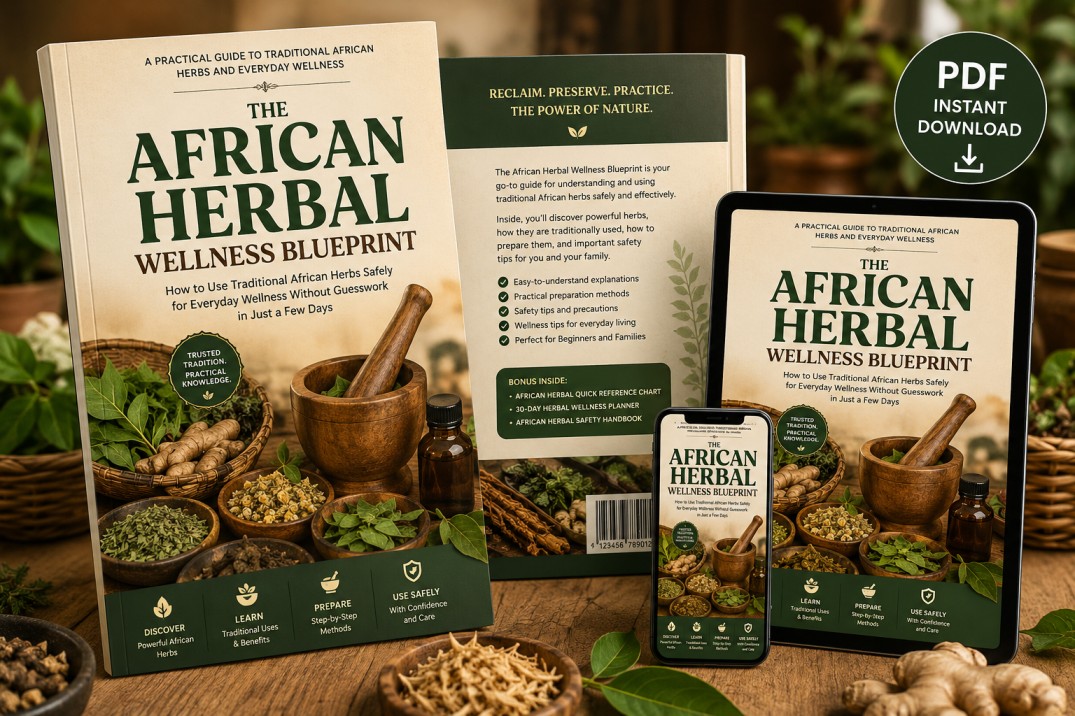
- ✓ The Core Framework: How African Herbs Actually Work in the Body — the missing knowledge most people never receive. (Page 4)
- ✓ The 12 Most Powerful Everyday African Herbs and Their Specific Uses — what each one does, how to prepare it the right way. (Page 9)
- ✓ Preparation Methods Decoded: Boiling vs. Soaking vs. Raw vs. Infusion — why the method matters as much as the herb. (Page 22)
- ✓ The Combination Rules: Which Herbs Work Together and Which Fight Each Other — the #1 mistake that wastes herbs and money. (Page 31)
- ✓ The 7-Day Starter Protocol for Everyday Wellness — exactly what to do, in what order, at what time. No guesswork. (Page 38)
- ✓ Foods and Habits That Block Herbal Effectiveness — hidden lifestyle factors that silently cancel everything out. (Page 47)
- ✓ Monthly Maintenance Plan and Extended Protocol for Stubborn Cases — how to sustain results long-term. (Page 54)
Everything available at your local Naija market. Total cost of ingredients? Less than ₦2,000.
Compare That to What You've Already Been Spending
How Much Does This Guide Cost?
- — Research and knowledge verification: ₦35,000
- — Professional writer: ₦28,000
- — Testing with 14 women over 8 weeks: ₦18,500
- — Design and layout: ₦12,000
- — Website setup: ₦9,000
- Total invested: ₦102,500
A fair price would be ₦15,000. But I know how tight things are. So if you take action today —
Once You Click That Button, Here Is What Happens
- You are taken to a secure payment page — card, bank transfer, or USSD.
- You complete payment. The whole process takes less than two minutes.
- Your guide is delivered to your WhatsApp and email within 60–90 seconds automatically.
It is me, Adomi. As long as your payment is confirmed, your access is 100% guaranteed.
What Happens in the First 7–14 Days
Real conversations. Real women. Real results.
WAIT — I Have Something Special For You…
If you are one of the first 50 women — you get these bonuses completely free.
A plain-language walkthrough showing you exactly how to begin from page one — so you start correctly, confidently, without confusion.
A printable chart listing the 12 key herbs — uses, preparation, safe combinations, what to avoid. Stick it on your kitchen wall. Take it to the market. Never guess again.
- ✓ The African Herbal Wellness Blueprint₦15,000
- ✓ Bonus 1: How to Use This Guide₦5,000
- ✓ Bonus 2: Quick Reference Chart₦4,000
- Total Value₦24,000
Right Now, You Have Two Choices
Choice 1: Do Nothing
- Keep buying herbs without a framework
- Keep spending on supplements that disappoint
- Keep waking up on half capacity
- Watch your energy stay stuck
- Come back in six months still asking why
Choice 2: Get the Blueprint
- Have the complete framework tonight
- Start the 7-day protocol tomorrow correctly
- Feel the first shifts within days
- Finally understand why herbs work
- Own knowledge that serves your family for life
🛡 30-Day Money-Back Guarantee
Follow the 7-day starter protocol exactly. Use it for 30 days. If you do not notice a meaningful, real difference — contact me directly and I will refund every naira. No arguments. No questions.
One Last Thing…
Picture yourself one month from today. Will you wake up with energy that feels like yours again? Will you move through your day without that familiar heaviness? Will the people around you notice something has shifted — not because you told them, but because it shows?
Now picture yourself one month from today if you close this page. The same fatigue. The same inconsistent results. Nothing changes unless something changes.
The difference between those two versions of you is a decision you make in the next sixty seconds.
I Am Ready. Give Me The Blueprint Now.If you have read this far and you are still hesitating —
It is not about ₦5,000. You have spent more than that this month on things that gave you far less. Your grandmother did not manage. She knew. She thrived. That same knowing is available to you right now, tonight.
Stop hesitating. Choose yourself.
YES — I Choose Myself.P.S. This comes with a full 30-day money-back guarantee. Follow the protocol for 30 days. If you feel no real difference, I refund every naira. The only risk is doing nothing.
P.P.S. This ₦5,000 price is only for the first 50 women who pay today. Once those spots are gone, the price returns to ₦15,000.
P.P.P.S. Every day you wait is another day of waking up tired, spending money on things that do not work, and carrying confusion this guide will erase on page one.
Adomi Ochuko
Frequently Asked Questions
How is the guide delivered after I pay?
The moment your payment is confirmed, the guide is delivered automatically to your WhatsApp and email within 60–90 seconds. No waiting, no manual sending — automatic and instant, day or night.
Are the herbs easy to find?
No special market needed. Every herb is available in your regular local market anywhere in Nigeria. Total cost of ingredients to begin the 7-day protocol is less than ₦2,000.
What if my situation has been going on for a long time?
The guide includes an extended protocol for stubborn or long-standing cases starting on page 54. Many women who reported the most dramatic results were using this extended protocol.
Is the money-back guarantee real?
Yes. Completely real. Follow the protocol exactly for 30 days. If you notice no meaningful improvement, contact me with your payment confirmation and I will process a full refund. No arguments, no questions.
Why is this different from everything else I have tried?
Everything else gave you a product without a framework. This guide gives you understanding — the same understanding that allowed your grandmother's generation to use these plants effectively for their entire lives.
© 2025 Roots & Remedies Nigeria · All Rights Reserved
For informational and educational purposes. Results may vary. Not a substitute for professional medical advice.
Comments (214)
I bought this for my wife and she has been using it for 10 days. The change in her energy is visible. Very grateful to Adomi.
👍 Like (47)The framework chapter changed my entire understanding. No wonder my results were never consistent. Ẹ jọ o — buy this thing.
👍 Like (83)The quick reference chart bonus is something else entirely. I printed it and put it on my kitchen wall. God bless you Adomi.
👍 Like (92)Our elders had this knowledge. Our generation lost it. This guide brings it back. Buy this. No regrets.
👍 Like (108)Leave a Comment